The Good Song
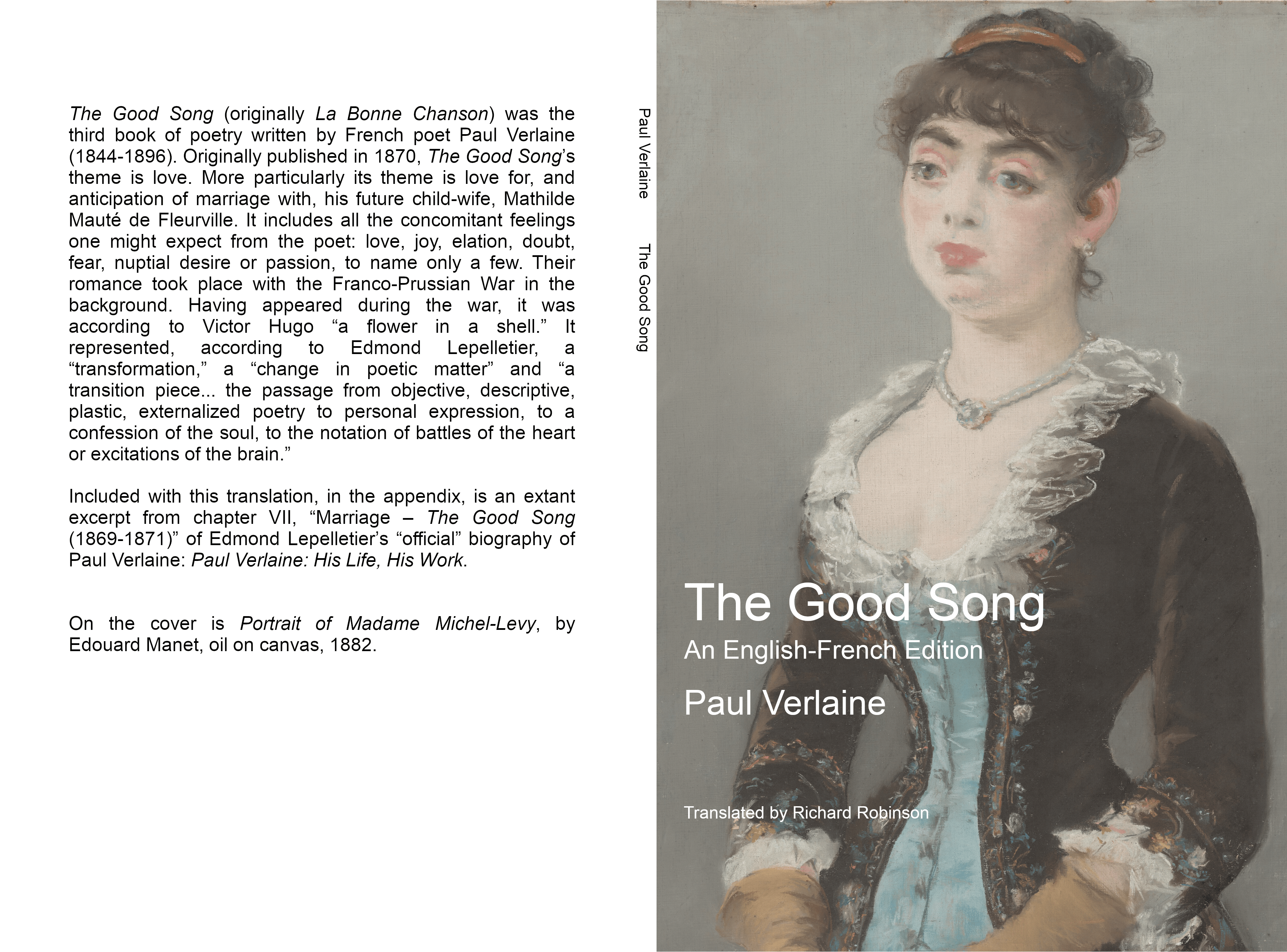
The Good Song (originally La Bonne Chanson) was the third book of poetry written by French poet Paul Verlaine (1844-1896). Originally published in 1870, The Good Songʼs theme is love. More particularly its theme is love for, and anticipation of marriage with, his future child-wife, Mathilde Mauté de Fleurville. It includes all the concomitant feelings one might expect from the poet: love, joy, elation, doubt, fear, nuptial desire or passion, to name only a few. Their romance took place with the Franco-Prussian War in the background. Having appeared during the war, it was according to Victor Hugo “a flower in a shell.” It represented, according to Edmond Lepelletier, a “transformation,” a “change in poetic matter” and “a transition piece... the passage from objective, descriptive, plastic, externalized poetry to personal expression, to a confession of the soul, to the notation of battles of the heart or excitations of the brain.”
Included with this translation, in the appendix, is an extant excerpt of chapter VII, “Marriage – The Good Song (1869-1871)” from Edmond Lepelletierʼs “official” biography of Paul Verlaine: Paul Verlaine: His Life, His Work.
Excerpt (from The Good Song)
The pale moon
Shines in the woods;
From each bough
Emerges a voice
Beneath the branches...
O beloved...
The pond reflects,
Profound mirror,
The silhouette
Of a dark willow
Where the wind weeps...
Letʼs dream, it is the hour,
A vast and tender
Appeasement
Seems to descend
From the firmament
That the star iridesces...
It is the exquisite hour.
View on Amazon