Yu Dafu (郁達夫)
Yu Dafu (AD 1896–1945) was a Chinese short-story writer and poet, born in Fuyang, Zhejiang. At sixteen he went to Japan, where he lived and studied for nearly a decade, completing his studies in economics at Tokyo Imperial University. He became fluent in Japanese and read widely in Western (primarily English and German) literature. In 1921, while still in Japan, he co-founded the Creation Society, a circle of young Chinese writers who championed modern vernacular literature.
That same year he published his most famous work, Chenlun (沉淪), offered here in English translation as Drowning. Its frank, thinly veiled autobiographical treatment of drinking, youthful angst, and frustrated sexuality -- its portrait, in short, of a lonely young Chinese student in Japan -- made him a literary celebrity in China when he returned in 1922. After the outbreak of war with Japan he wrote anti-Japanese propaganda, then worked as a newspaper editor in Singapore. When Singapore fell in 1942 he fled to Sumatra and lived there under an assumed name. In September 1945, shortly after Japanʼs surrender, he was reportedly executed by Japanese military police.
Books in English Translation
A Silver-Grey Death & Drowning (Novella, Decadentism)
Drowning (Novella, Decadentism)
Featured Title
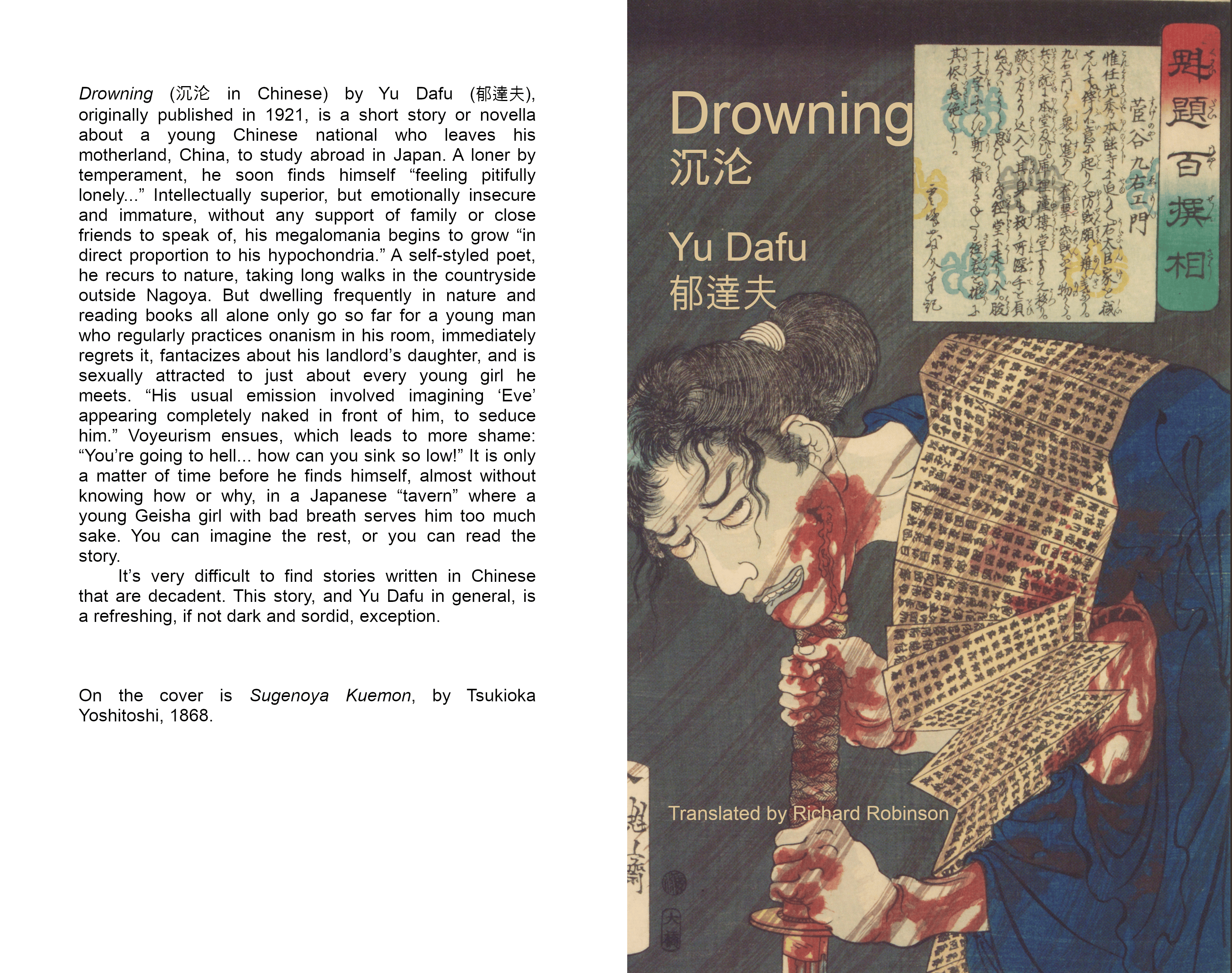
Drowning
By Dafu Yu
Drowning (沉淪 in Chinese) by Yu Dafu (郁達夫), originally published in 1921, is a short story or novella about a young Chinese national who leaves his motherland, China, to study abroad in Japan. A loner by temperament, he soon finds himself “feeling pitifully lonely...” Intellectually superior, but emotionally insecure and immature, without any support of family or close friends to speak of, his megalomania begins to grow “in direct proportion to his hypochondria.” A self-styled poet, he recurs to nature, taking long walks in the countryside outside Nagoya. But dwelling frequently in nature and reading books all alone only go so far for a young man who regularly practices onanism in his room, immediately regrets it, fantasizes about his landlordʼs daughter, and is sexually attracted to just about every young girl he meets. “His usual emission involved imagining ʻEveʼ appearing completely naked in front of him, to seduce him.” Voyeurism ensues, which leads to more shame: “Youʼre going to hell... how can you sink so low!” It is only a matter of time before he finds himself, almost without knowing how or why, in a Japanese “tavern” where a young Geisha girl with bad breath serves him too much sake. You can imagine the rest, or you can read the story.
Itʼs very difficult to find stories written in Chinese that are decadent. This story, and Yu Dafu in general, is a refreshing, if not dark and sordid, exception.
View on Amazon