
Alfredo Rocco

Alfredo Rocco (AD 1875–1935) was one of modern Italy’s foremost jurists, legal scholars, nationalist theorists, and the principal legislative architect of the Fascist regime. Emerging from the authoritarian right as a leading ideologue of the Italian Nationalist Association -- founded by Enrico Corradini -- before its merger into Benito Mussolini’s National Fascist Party in 1923, Rocco rejected liberalism, individualism, parliamentary democracy, and Marxist class struggle alike. In their place, he advanced an organic, hierarchical conception of the state in which individual rights exist only insofar as they serve the collective life, national production, and imperial power of the nation. As Mussolini’s Minister of Justice from 1925 to 1932, Rocco translated doctrine into positive law, drafting the sweeping “ultra-Fascist” statutes that dismantled Italy’s parliamentary order, outlawed opposition parties and independent labor unions, established state-controlled corporatism, and overhauled the Italian penal code.

Works in English Translation

What Is Nationalism and What Do Nationalists Want? (Italian Politics, Politics, Nationalism)
Featured Title

What Is Nationalism and What Do Nationalists Want? by Alfredo Rocco

What Is Nationalism and What Do Nationalists Want?

By Alfredo Rocco

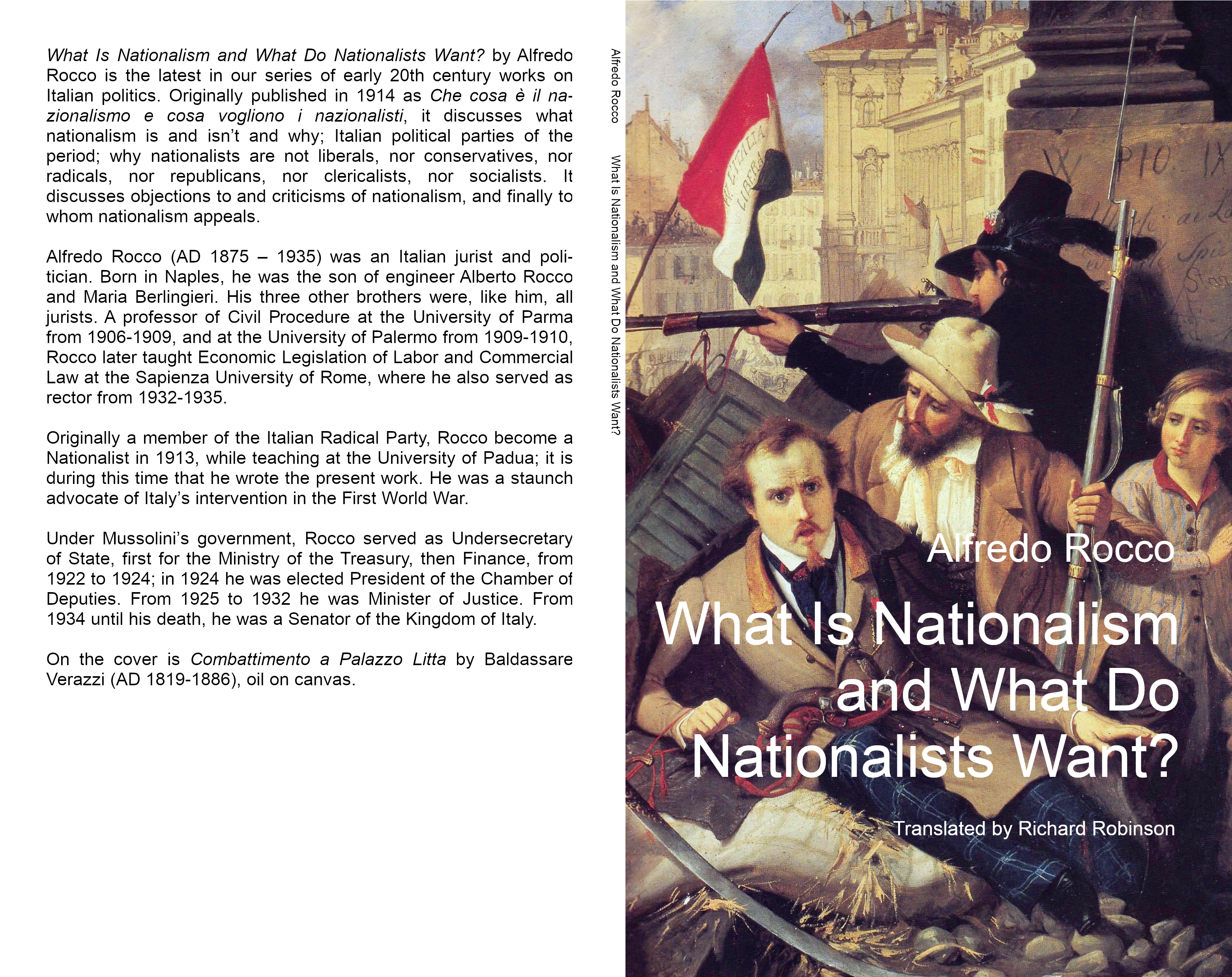
What Is Nationalism and What Do Nationalists Want? by Alfredo Rocco is the latest in our series of early 20th century works on Italian politics. Originally published in 1914 as Che cosa è il nazionalismo e che cosa vogliono i nazionalisti, it discusses what nationalism is and isnʼt and why; Italian political parties of the period; why nationalists are not liberals, nor conservatives, nor radicals, nor republicans, nor clericalists, nor socialists. It discusses objections to and criticisms of nationalism, and finally to whom nationalism appeals.

Alfredo Rocco (AD 1875 – 1935) was an Italian jurist and politician. Born in Naples, he was the son of engineer Alberto Rocco and Maria Berlingieri. His three other brothers were, like him, all jurists.

A Professor of Civil Procedure at the University of Parma from 1906-1909, and at the University of Palermo from 1909-1910, Rocco later taught Economic Legislation of Labor and Commercial Law at the Sapienza University of Rome, where he also served as rector from 1932-1935.

Originally a member of the Italian Radical Party, Rocco became a Nationalist in 1913, while teaching at the University of Padua; it is during this time that he wrote the present work. He was a staunch advocate of Italyʼs intervention in the First World War.

Rocco was responsible for, and his name is associated with, the Italian Penal Code (the Codice Rocco) much of which remains in force in Italy today and which he had a direct hand in.

Under Mussoliniʼs government, Rocco served as Undersecretary of State, first for the Ministry of the Treasury, then Finance, from 1922 to 1924; in 1924 he was elected President of the Chamber of Deputies. From 1925 to 1932 he was Minister of Justice. From 1934 until his death, he was a Senator of the Kingdom of Italy.

View on Amazon