
Jean Raspail

Jean Raspail (AD 1925–2020) was one of France’s most singular literary figures: an explorer who traveled the world, a novelist, a royalist and traditionalist, and a chronicler of lost kingdoms and vanishing peoples. Over a fifty-year career he wrote roughly forty books, and he won the Académie française’s Grand Prix du Roman in 1981. He even served as self-appointed Consul General of the Kingdom of Araucanía and Patagonia in South America.

Outside France he is best known for dystopian novel The Camp of the Saints (1973). Septentrion (1979), also a dystopian novel, shares themes with it, but whereas in the former the enemy comes from without, in Septentrion the enemy, the demos, comes from within. The latter novel also shares themes with several of his later works, including Sept cavaliers..., Hurrah Zara! and Les Royaumes de Borée.

Books in English Translation

Septentrion (Novel, Dystopia, Nationalism)
Featured Title

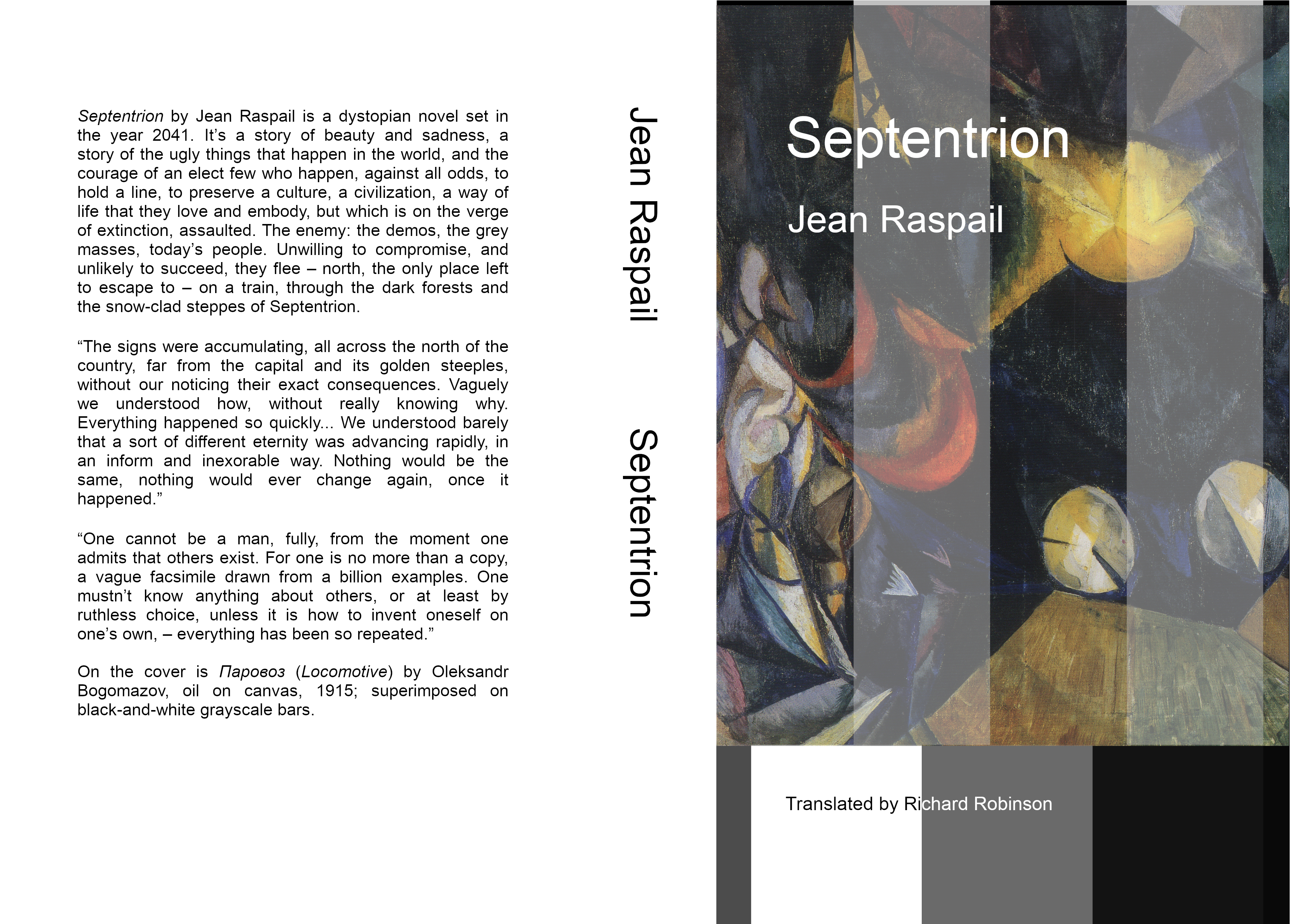
Septentrion by Jean Raspail

Septentrion

By Jean Raspail

Septentrion by Jean Raspail is a dystopian novel set in the year 2041. Itʼs a story of beauty and sadness, a story of the ugly things that happen in the world, and the courage of an elect few who happen, against all odds, to hold a line, to preserve a culture, a civilization, a way of life that they love and embody, but which is on the verge of extinction, assaulted. The enemy: the demos, the grey masses, todayʼs people. Unwilling to compromise, and unlikely to succeed, they flee – north, the only place left to escape to – on a train, through the dark forests and the snow-clad steppes of Septentrion.

“The signs were accumulating, all across the north of the country, far from the capital and its golden steeples, without our noticing their exact consequences. Vaguely we understood how, without really knowing why. Everything happened so quickly... We understood barely that a sort of different eternity was advancing rapidly, in an inform and inexorable way. Nothing would be the same, nothing would ever change again, once it happened.”

“One cannot be a man, fully, from the moment one admits that others exist. For one is no more than a copy, a vague facsimile drawn from a billion examples. One mustnʼt know anything about others, or at least by ruthless choice, unless it is how to invent oneself on oneʼs own, – everything has been so repeated.”

View on Amazon