
William of Ockham

William of Ockham (AD 1287–1347) was an English Franciscan friar, philosopher, and logician whose nominalism and commitment to ontological parsimony helped dismantle the philosophical architecture of medieval Scholasticism. Stripping away centuries of Neoplatonic metaphysics that had been layered onto Aristotle, Ockham argued that universal concepts and abstract essences exist only in the mind and language—never as real things. By slicing, as if with a razor, through the rational framework long used to explain doctrines like the Trinity, he severed faith from philosophical proof and unintentionally shaped what would later serve as a groundwork for the Protestant Reformation, the Enlightenment, and scientific empiricism. Summoned to the papal court at Avignon to defend his writings against suspicions of heresy, Ockham turned the tables by accusing Pope John XXII himself of heresy, leading to his excommunication and flight to the Duchy of Bavaria, where he spent the rest of his days.

Works in English Translation

Fallacies: Part 3, Book 4 of Summa Logicae (Logic)
Featured Title

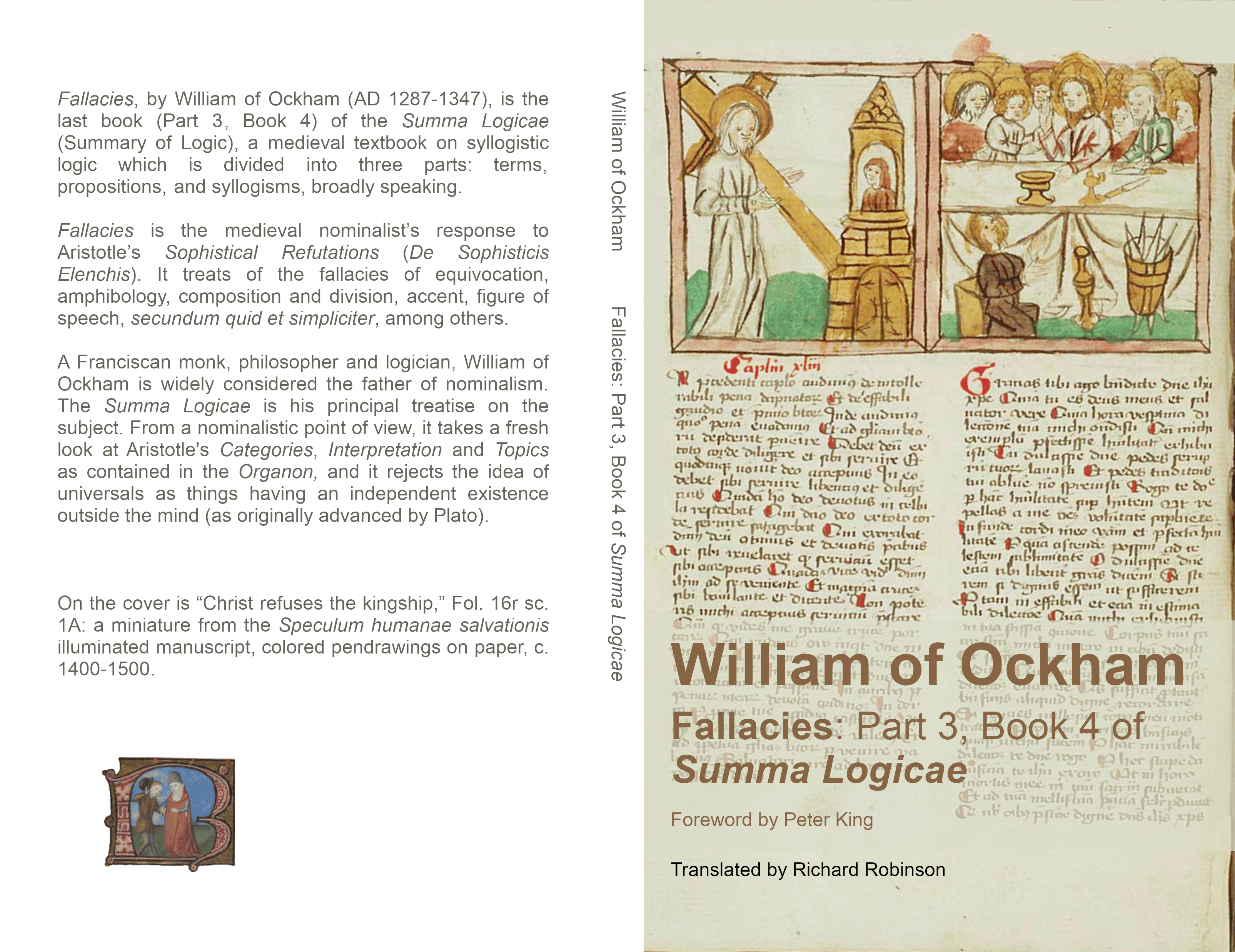
Fallacies: Part 3, Book 4 of Summa Logicae by William of Ockham

Fallacies: Part 3, Book 4 of Summa Logicae

By William of Ockham

Fallacies, by William of Ockham (AD 1287-1347), is the last book (Part 3, Book 4) of Summa Logicae (Summary of Logic), a medieval textbook on syllogistic logic which is divided into three parts: terms, propositions and syllogisms, broadly speaking.

Fallacies is the medieval nominalistʼs response to Aristotleʼs Sophistical Refutations (De Sophisticis Elenchis). It treats of the fallacies of equivocation, amphibology, composition and division, accent, figure of speech, secundum quid et simpliciter, among others.

A Franciscan monk, philosopher and logician, William of Ockham is widely considered the father of nominalism. The Summa Logicae is his principal treatise on the subject. From a nominalistic point of view, it takes a fresh look at Aristotleʼs "Categories," "Interpretation" and "Topics" as contained in the Organon; and it rejects the idea of universals as things having an independent existence outside the mind (originally advanced by Plato).

View on Amazon