
Francis Vielé-Griffin

Francis Vielé-Griffin (AD 1864–1937), the American-born son of a Civil War officer, crossed the Atlantic as a boy and became, over time, one of the premier Symbolist poets of French literature. Educated in Paris, he rejected the rigid metronome of the traditional French alexandrine and Parnassianism, and championed vers libre, or free verse, with the conviction that poetic rhythm should follow the organic cadence of thought and breath rather than inherited counting rules. Unlike the darker, absinthe-steeped Decadents (later rebranded Symbolists) of his generation, Vielé-Griffin soberly infused Symbolism with an airy, sunlit paganism, blending classical myth, medieval legend, and the pastoral landscapes of the Loire Valley into luminous, fluid lyricism. Though he never surrendered his American citizenship, he stood at the very center of the Parisian avant-garde, editing influential reviews, mentoring young modernists, and contributing to French letters.

Although a foreigner, he proved that he could hear -- and produce -- the music of the French language keenly enough to liberate its verse from centuries of formal constraint.

Symbolist Poetry in English Translation

April Harvest, Swans, and Joys (Poetry, Symbolist Poetry)
Cull of April (Poetry, Symbolist Poetry)
Joys (Poetry, Symbolist Poetry)
Swans (Poetry, Symbolist Poetry)
The Ride of Yeldis & Other Poems (Poetry, Symbolist Poetry)
Featured Title

April Harvest, Swans, and Joys by Francis Vielé-Griffin

April Harvest, Swans, and Joys

By Francis Vielé-Griffin

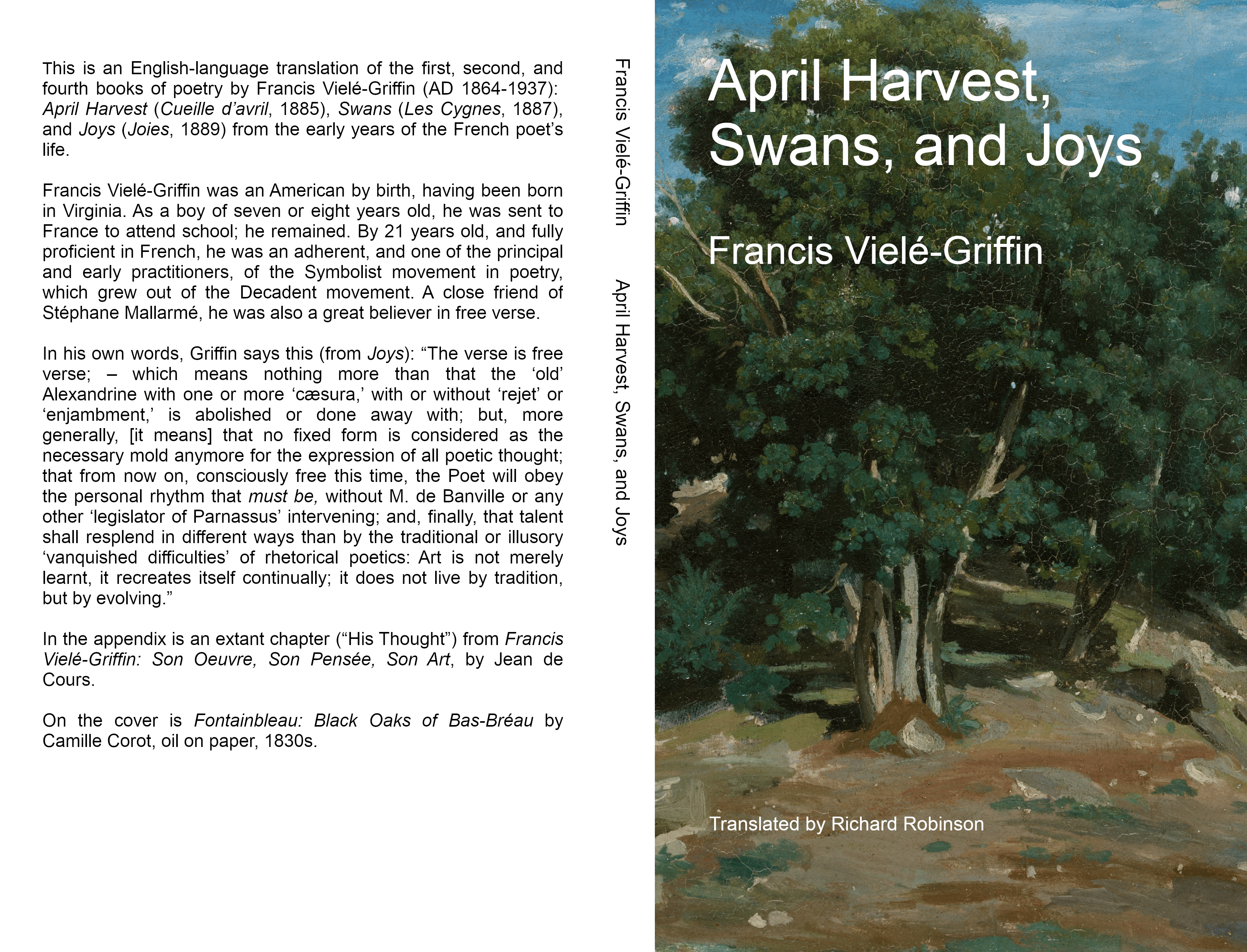
April Harvest, Swans, and Joys is an English-language translation of the first, second, and fourth books of poetry by Francis Vielé-Griffin (AD 1864-1937): April Harvest (Cueille dʼavril, 1885), Swans (Les Cygnes, 1887), and Joys (Joies, 1889) from the early years of the French poetʼs life.

Francis Vielé-Griffin was an American by birth, having been born in Virginia. As a boy of seven or eight years old, he was sent to France to attend school; he remained. By 21 years old, and fully proficient in French, he was an adherent, and one of the principal and early practitioners, of the Symbolist movement in poetry, which grew out of the Decadent movement. A close friend of Stéphane Mallarmé, he was also a great believer in free verse.

In his own words, Griffin says this (from Joys): “The verse is free verse; – which means nothing more than that the ʻoldʼ Alexandrine with one or more ʻcæsura,ʼ with or without ʻrejetʼ or ʻenjambment,ʼ is abolished or done away with; but, more generally, [it means] that no fixed form is considered as the necessary mold anymore for the expression of all poetic thought; that from now on, consciously free this time, the Poet will obey the personal rhythm that must be, without M. de Banville or any other ʻlegislator of Parnassusʼ intervening; and, finally, that talent shall resplend in different ways than by the traditional or illusory ʻvanquished difficultiesʼ of rhetorical poetics: Art is not merely learnt, it recreates itself continually; it does not live by tradition, but by evolving.”

In the appendix is an extant chapter (“His Thought”) from Francis Vielé-Griffin: Son Oeuvre, Son Pensée, Son Art, by Jean de Cours.

View on Amazon