
Charles Chappuis

Charles Chappuis (AD 1822–1897) was a French teacher, university professor, and administrator born at Saint-Vit in the Doubs, France. He trained as a philosopher at the École Normale in Paris, where he became close friends with the young Louis Pasteur. The two had already been companions at the lycée in Besançon. Chappuis earned the agrégation (a competitive exam for recruiting teachers) in philosophy and went on to a long career in French education, serving as dean of the Faculty of Letters at Dijon and finally as honorary Inspector General of public instruction.

His study on Antisthenes appeared in Paris in 1854 and is still cited in bibliographies on the Socratic schools. In it he argues that Antisthenes, devoted student of Socrates, deserves a place beside his master as the true founder of Cynicism. Chappuis also wrote on classical antiquity more broadly, and his last work, Annibal dans les Alpes (Hannibal in the Alps), was published in 1897, the year he died in Paris.

Books in English Translation

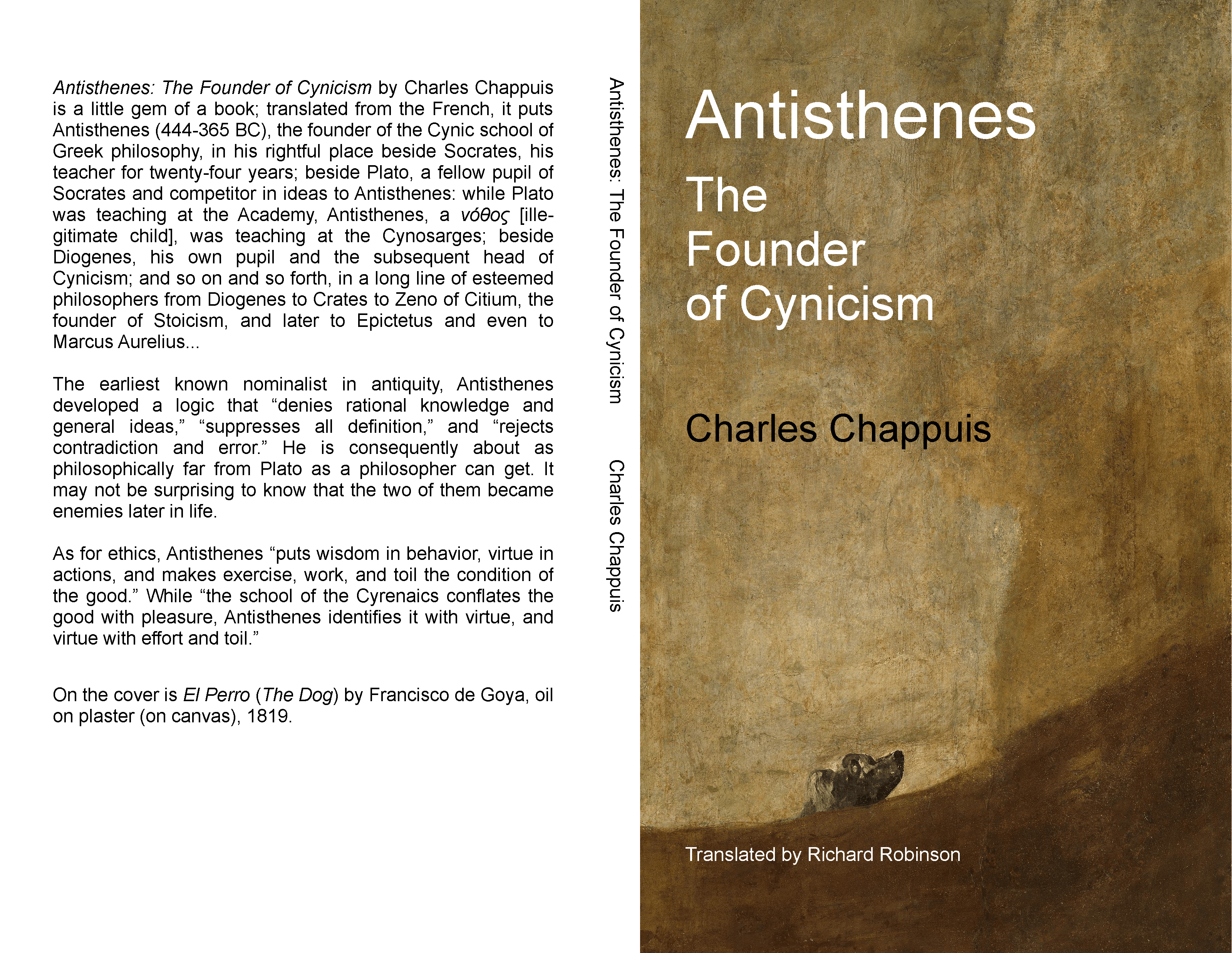
Antisthenes: The Founder of Cynicism (Philosophy, Cynicism, Biography)
Featured Title

Antisthenes: The Founder of Cynicism by Charles Chappuis

Antisthenes: The Founder of Cynicism

By Charles Chappuis

Antisthenes: The Founder of Cynicism by Charles Chappuis is a little gem of a book; translated from the French, it puts Antisthenes (444-365 BC), the founder of the Cynic school of Greek philosophy, in his rightful place beside Socrates, his teacher for twenty-four years; beside Plato, a fellow pupil of Socrates and competitor in ideas to Antisthenes: while Plato was teaching at the Academy, Antisthenes, a νόθος [illegitimate child], was teaching at the Cynosarges; beside Diogenes, his own pupil and the subsequent head of Cynicism; and so on and so forth, in a long line of esteemed philosophers from Diogenes to Crates to Zeno of Citium, the founder of Stoicism, and later to Epictetus and even to Marcus Aurelius...

The earliest known nominalist in antiquity, Antisthenes developed a logic that “denies rational knowledge and general ideas,” “suppresses all definition,” and “rejects contradiction and error.” He is consequently about as philosophically far from Plato as a philosopher can get. It may not be surprising to know that the two of them became enemies later in life.

As for ethics, Antisthenes “puts wisdom in behavior, virtue in actions, and makes exercise, work, and toil the condition of the good.” While “the school of the Cyrenaics conflates the good with pleasure, Antisthenes identifies it with virtue, and virtue with effort and toil.”

View on Amazon